# Custom Software vs. Off-the-Shelf Software: Which Is Right for Your Business?
Choosing software for your business is not simply a technology decision. It can affect how your employees work, how your teams manage information, how customers interact with your company, and how easily your business can grow.
Many businesses face the same question:
**Should we buy an existing software product, or should we build software specifically for our business?**
There is no universal answer. Off-the-shelf software can be the right choice for many businesses, while custom software can make more sense when existing tools cannot support the way the business operates.
The right decision depends on your workflows, requirements, budget, integrations, scalability needs, and long-term goals.
https://www.qncept.com/solutions/custom-software-development
## What Is Off-the-Shelf Software?
Off-the-shelf software is a ready-made product developed for a broad group of customers.
Examples include:
* CRM platforms * Accounting software * Project management tools * HR systems * Inventory management platforms * Marketing automation tools * Communication and collaboration software
Instead of developing the software yourself, your business subscribes to or purchases an existing solution.
The main advantage is speed. You can usually start using the software much faster than developing a new system from scratch.
## What Is Custom Software?
Custom software is designed and developed specifically for a particular business, organization, or use case.
Instead of changing your business processes to fit an existing product, the software is designed around your actual workflows.
A custom system might include:
* Business-specific workflows * Custom dashboards * Role-based permissions * Automated approvals * Internal tools * Custom reporting * Third-party integrations * Mobile applications * Customer portals * Industry-specific functionality * API integrations * Business process automation
Qncept, for example, approaches custom software by first understanding how teams actually work before designing the system and its architecture. Its current service offering includes process discovery, workflow automation, integrations, reporting, internal tools, and legacy-system modernization.
## Off-the-Shelf vs. Custom Software
The fundamental difference is simple:
**Off-the-shelf software is built for many businesses.**
**Custom software is built around the requirements of your business.**
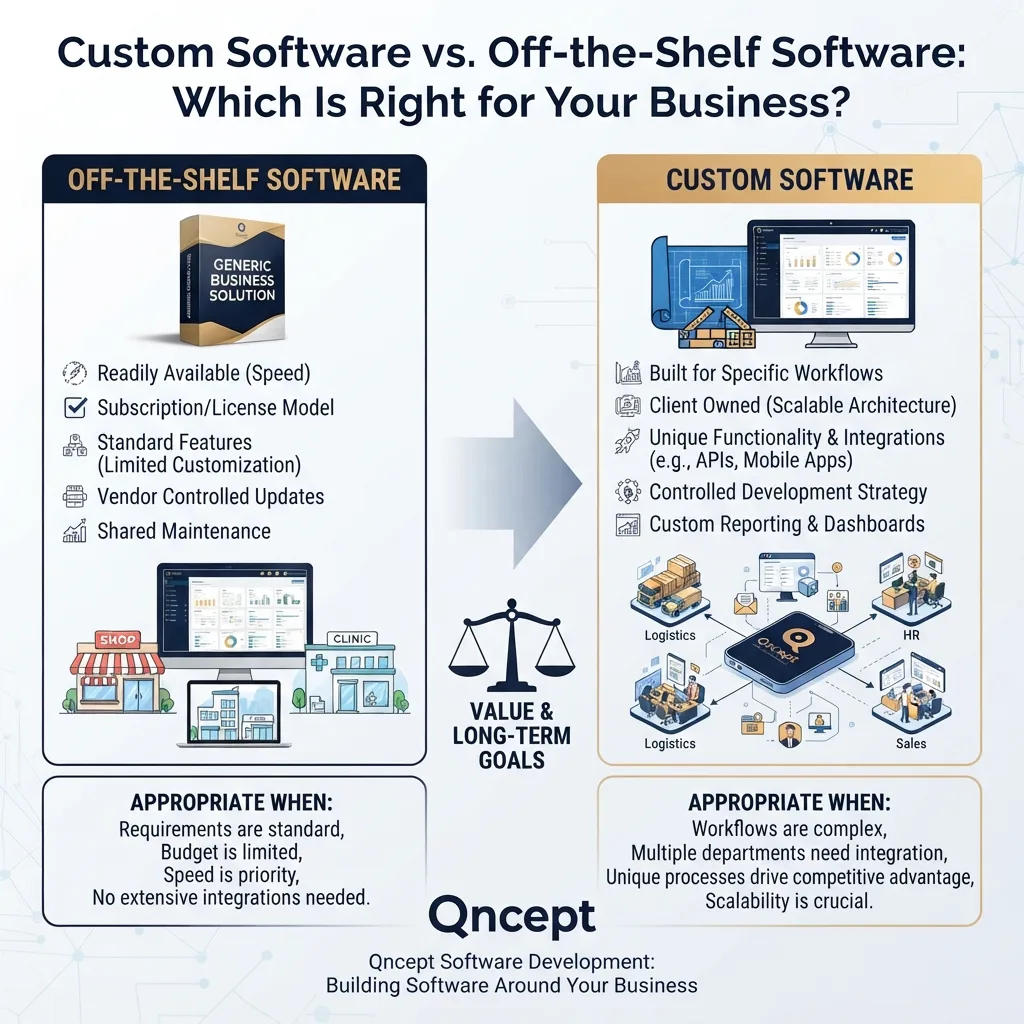
| Factor | Off-the-Shelf Software | Custom Software | | --------------------------- | --------------------------------- | ------------------------------------------------- | | Initial cost | Usually lower | Usually higher | | Implementation | Usually faster | Usually longer | | Customization | Limited to available options | Designed around your requirements | | Business workflows | Must generally fit the product | Can be built around your processes | | Integrations | Depends on available integrations | Can be developed specifically for your systems | | Scalability | Depends on the provider | Architecture can be designed for your growth | | Ownership | Usually subscription/license | Typically owned by the client | | Updates | Controlled by vendor | Controlled according to your development strategy | | Competitive differentiation | Limited | Can support unique processes | | Maintenance | Usually handled by vendor | Requires a development/support strategy |
Neither option is automatically better. The question is whether the software matches the problem you are trying to solve.
## When Off-the-Shelf Software Makes Sense
Buying existing software can be a practical choice when your business has relatively standard requirements.
For example, if you need:
* Basic accounting * Standard project management * Email marketing * Team communication * Basic CRM functionality * Standard document management * Common HR functions
there may already be mature products that can meet your needs.
In these situations, building a completely new system may add unnecessary cost and development time.
### Off-the-shelf software may be appropriate when:
**Your requirements are standard**
If your business processes are similar to those supported by existing products, customization may not provide enough additional value.
**You need a solution quickly**
A ready-made platform can often be configured and deployed much faster than developing a new application.
**Your budget is limited**
Subscription software generally requires less upfront investment than building a complete custom platform.
**You do not need extensive integrations**
If the software already connects with the systems you use, additional development may not be necessary.
## When Custom Software Makes Sense
Custom software becomes more relevant when your business processes are difficult to represent using existing products.
This can happen when your company has:
* Complex workflows * Multiple departments * Specialized business rules * Large amounts of operational data * Multiple systems that need to communicate * Unique reporting requirements * Industry-specific requirements * Complex approval processes * Growing automation requirements
For example, a logistics company may need software that combines fleet management, maintenance, fuel, drivers, expenses, inspections, assignments, and reporting.
A generic platform may provide some of these capabilities, but the company may still need spreadsheets, manual processes, and multiple disconnected tools to fill the gaps.
A custom platform can instead connect these workflows into one system.
## 7 Signs Your Business May Need Custom Software
### 1. Your Team Relies Heavily on Spreadsheets
Spreadsheets are useful, but they can become difficult to manage when multiple employees, departments, and processes depend on them.
If employees constantly copy data between spreadsheets and systems, the underlying problem may be a lack of connected software.
### 2. Employees Perform the Same Tasks Manually
Repeated data entry, manual approvals, repetitive reporting, and constant follow-up activities can consume significant employee time.
Software automation can reduce unnecessary manual work when the process is predictable and well-defined.
### 3. Your Existing Software Does Not Match Your Workflow
A common problem with ready-made platforms is that businesses may have to create workarounds to accomplish basic tasks.
If employees frequently say:
> "The system doesn't work this way, so we have to do it manually."
that may indicate a gap between your business process and the software.
### 4. Your Business Uses Multiple Disconnected Systems
For example:
```text CRM ↓ Excel ↓ Accounting Software ↓ Email ↓ WhatsApp ↓ Internal System ```
When information is distributed across multiple platforms, employees may spend unnecessary time moving information between systems.
Custom software can potentially integrate these systems through APIs and automated workflows.
### 5. You Need Reports Your Existing Software Cannot Provide
Standard software typically provides predefined reports.
But businesses sometimes require reporting based on their own operational rules.
A custom reporting system can be designed around the metrics that matter to the organization.
### 6. Your Business Has Unique Processes
If your competitive advantage depends on a particular process, forcing that process into generic software may create unnecessary limitations.
Custom software can encode those processes directly into the application.
### 7. Your Business Is Growing
A system that works for 10 employees may become difficult to manage with 100 employees.
As organizations grow, they often need:
* Better permissions * More automation * Centralized information * Advanced reporting * System integrations * Better data governance * More scalable architecture
Growth does not automatically mean you need custom software, but it can make the decision more important.
## Custom Software Does Not Mean Building Everything From Scratch
One common misconception is that custom software means creating every component from zero.
In reality, a custom application can use existing technologies, cloud services, APIs, payment providers, authentication services, databases, and other established components.
For example, a business application could combine:
```text Custom Application │ ├── CRM ├── Payment Gateway ├── Email ├── WhatsApp ├── Accounting System ├── Google Calendar └── Business Intelligence ```
The custom part is the way these components are connected and how the application implements the company's specific workflows.
## What About Cost?
Cost is one of the biggest differences between the two approaches.
Off-the-shelf software generally has a lower initial cost because development is distributed across many customers.
Custom software requires an investment in:
* Discovery * UX/UI design * Architecture * Development * Testing * Deployment * Infrastructure * Maintenance
However, looking only at the initial development cost can give an incomplete picture.
A business should also consider the ongoing cost of:
* Multiple software subscriptions * Manual work * Duplicate data entry * Operational errors * Customization fees * Integration limitations * Switching between platforms * Processes that cannot be automated
The right comparison is therefore not simply:
**"Which option is cheaper?"**
It is:
**"Which option provides the best long-term value for our business requirements?"**
## How to Decide Between Custom and Off-the-Shelf Software
Consider these questions:
### 1. Are your processes standard?
If yes, an existing platform may be sufficient.
### 2. Are your workflows unique or complex?
If yes, custom development may provide more flexibility.
### 3. How many systems do you currently use?
The more disconnected systems you have, the more important integration becomes.
### 4. How much manual work exists?
If employees spend significant time performing repetitive tasks, automation may justify a custom solution.
### 5. How important is scalability?
If the system must support significant growth, architecture should be considered from the beginning.
### 6. Do you need ownership and control?
Custom software can give your organization greater control over functionality, development priorities, and integrations.
### 7. What happens if the existing platform changes?
With third-party software, pricing, features, APIs, and policies can change.
Your business should consider how dependent its operations are on the vendor.
## A Hybrid Approach Can Also Work
You do not always have to choose one approach for everything.
A business can use existing software for standard functions while developing custom applications for processes that require differentiation.
For example:
```text Accounting → Existing Platform
Email → Existing Platform
Communication → Existing Platform
Core Operations → Custom Software
Business Workflows → Custom Software
Reporting → Custom Dashboard
Integrations → APIs ```
This approach can provide a balance between speed, cost, and customization.
## How Qncept Approaches Custom Software Development
Custom software should begin with understanding the business problem—not with choosing a programming language.
Qncept's current development approach starts with process discovery, followed by solution design, iterative development, testing, and rollout. Its custom software capabilities include workflow automation, system integrations, internal dashboards, role-based permissions, reporting, and legacy-system modernization.
The objective is not simply to create another application.
It is to build software that fits the way the organization actually operates.
## Final Thoughts
There is no universal winner between custom and off-the-shelf software.
Off-the-shelf software can be a practical choice when your requirements are standard, your budget is limited, and you need to deploy quickly.
Custom software becomes more relevant when your business has specialized workflows, complex integrations, significant automation requirements, or processes that existing platforms cannot adequately support.
The most important question is not:
**"Should we build or buy?"**
It is:
**"What does our business actually need the software to accomplish?"**
Once that question is clearly answered, the right technology strategy becomes much easier to determine.
### Need Software Built Around Your Business?
If existing tools are forcing your team to change the way it works, it may be time to explore a custom solution.
Qncept helps businesses turn complex workflows into scalable digital products, internal platforms, and automated business systems.
**Tell us about your workflow and let's explore the right solution for your business.**