
# How Much Does Custom Software Development Cost in 2026? A Practical Guide
One of the first questions businesses ask when considering custom software development is:
**How much will it cost?**
It is a reasonable question, but there is no single price that applies to every software project.
Building a simple internal business tool is very different from developing a CRM, SaaS platform, healthcare system, marketplace, or enterprise application.
The cost depends on the scope, complexity, integrations, number of users, platforms, security requirements, design, infrastructure, and long-term development needs.
Instead of looking for one fixed number, businesses should understand **what determines software development cost and how to estimate a realistic budget before development begins.**
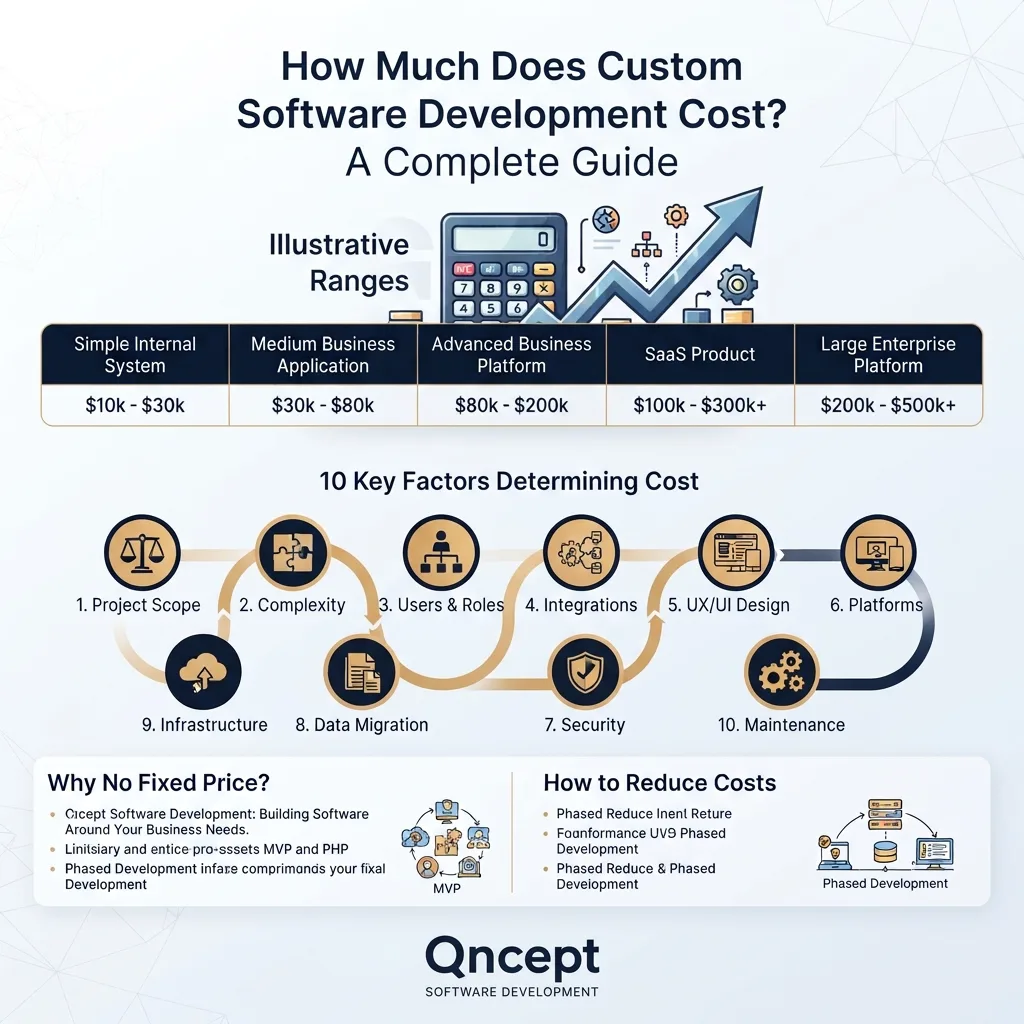
## How Much Does Custom Software Development Cost in 2026?
As a broad planning reference, custom software projects can fall into very different investment ranges:
| Project Type | Illustrative Cost Range | | ------------------------------- | ----------------------: | | Simple internal business system | $10,000 – $30,000 | | Medium business application | $30,000 – $80,000 | | Advanced business platform | $80,000 – $200,000 | | SaaS product | $100,000 – $300,000+ | | Large enterprise platform | $200,000 – $500,000+ |
These are **illustrative planning ranges, not fixed Qncept prices or quotations**.
Actual costs can vary significantly depending on the development market, project requirements, technology, team structure, integrations, security, and scope.
Published 2026 cost guides similarly show wide ranges because "custom software" covers projects with very different levels of complexity.
## Why Is There No Fixed Price for Custom Software?
The word "software" can describe very different products.
For example, there is a major difference between:
**An internal dashboard**
and
**An ERP system**
or between:
**A basic CRM**
and
**A SaaS platform serving thousands of customers.**
A small application may have a limited number of screens and a straightforward database.
A larger platform may require:
* Dozens of screens * Multiple user roles * Advanced permissions * Mobile applications * APIs * Third-party integrations * Advanced reporting * Notifications * Payment processing * Large datasets * High security requirements * Scalable infrastructure
This is why an accurate estimate requires more than simply knowing the name of the software.
# 10 Factors That Determine Custom Software Cost
## 1. Project Scope
The larger the project scope, the more analysis, design, development, and testing it generally requires.
There is a significant difference between:
**A system with three core business processes**
and
**A platform with 15 interconnected modules.**
However, the number of features alone does not determine the cost.
One highly complex feature can require more development and testing than several simple features.
---
## 2. Business Process Complexity
Not every software workflow has the same level of complexity.
For example:
**Creating a new customer**
is relatively straightforward.
But:
**Creating a multi-level approval workflow based on department, employee role, transaction value, customer status, and budget**
requires significantly more business logic.
The more rules, exceptions, conditions, and scenarios the system needs to handle, the more development and testing may be required.
---
## 3. Number of Users and Roles
Will the system be used by:
* 5 employees? * 100 employees? * 10,000 users? * Millions of customers?
You also need to consider user roles.
For example:
```text Super Admin ↓ Company Admin ↓ Manager ↓ Employee ↓ Customer ```
Each role may require different permissions, workflows, dashboards, and access levels.
This affects the application's architecture, database design, security, and testing.
---
## 4. Integrations
Integrations can have a significant impact on project cost.
A software application may need to connect with:
* CRM systems * ERP systems * Accounting platforms * Payment gateways * WhatsApp * Email * Google Calendar * Google Maps * SMS providers * Social media platforms * Government APIs * External databases
Each integration may require research, development, authentication, data mapping, error handling, and testing.
A project with no external integrations is very different from one that depends on 10 or 15 external systems.
Qncept's custom software offering includes integrations with systems such as ERP, CRM, payment gateways, and internal business systems through APIs. [Qncept — Custom Software Development](https://www.qncept.com/solutions/custom-software-development?utm_source=chatgpt.com)
---
## 5. UX and UI Design
Software development is not only about writing code.
A serious business application may also require:
* User research * User flows * Wireframes * UI design * Design systems * Responsive design * Usability testing
If employees use the system every day, usability can have a direct impact on adoption and productivity.
Investing in a clear user experience can therefore be part of the overall software development budget.
---
## 6. Platforms
Do you need:
* Web application only? * Android application? * iOS application? * Web + mobile? * Customer application + admin dashboard?
Developing for multiple platforms increases the scope of the project.
For example:
```text Web Application + Android App + iOS App + Admin Dashboard ```
is significantly broader than developing:
```text Web Application ```
alone.
---
## 7. Security Requirements
Not every application requires the same level of security.
Depending on the business and data involved, a project may require:
* Authentication * Two-factor authentication * Role-based access control * Encryption * Audit logs * Data backups * Security monitoring * Secure APIs
Security requirements can be particularly important for applications handling financial, healthcare, customer, or other sensitive information.
---
## 8. Data Migration
If your company already has a legacy system, you may need to move existing information into the new application.
Data may currently exist in:
* Excel files * SQL databases * Legacy applications * CRM systems * ERP systems * Multiple disconnected files
Data migration is not simply a matter of copying information.
It may involve:
**Extract → Clean → Transform → Validate → Import**
The size and quality of the existing data can therefore affect the project scope.
---
## 9. Infrastructure and Hosting
Once software has been developed, it needs to run in a production environment.
Depending on the project, infrastructure may include:
* Cloud hosting * Databases * File storage * Backups * CDN * Monitoring * Domain * SSL * Email services * Third-party APIs
The infrastructure should also be designed around expected usage and future growth.
---
## 10. Maintenance and Development After Launch
Launching the software is not necessarily the end of the project.
After launch, businesses may need:
* Bug fixes * Security updates * Performance improvements * New features * Monitoring * Infrastructure management * Technical support
A realistic software budget should therefore consider both **initial development** and **ongoing ownership costs**.
# Does the Number of Screens Determine the Cost?
Not necessarily.
A client might say:
> "The application only has 20 screens."
But that does not tell us how complex the application is.
For example, a single dashboard could contain:
* 10 KPIs * 5 charts * Multiple filters * Role-based views * Real-time data * Multiple APIs * Export functionality * Different views for different users
So estimating a project based only on the number of screens can be misleading.
The more important question is:
**What does each screen actually need to do?**
# A Practical Example
Imagine a company wants to develop an internal business management system.
The application includes:
* Login * Four user roles * Customer management * Order management * Dashboard * Reports * Notifications * Accounting integration
The project involves much more than creating several screens.
It requires:
**Requirements Analysis**
↓
**UX/UI Design**
↓
**Frontend Development**
↓
**Backend Development**
↓
**Database**
↓
**Integration**
↓
**Testing**
↓
**Deployment**
↓
**Training & Support**
This is why software estimates should be based on the complete scope rather than the number of screens.
# How Can You Reduce Software Development Costs?
Reducing cost does not necessarily mean choosing the cheapest development company.
There are more effective ways to control the budget.
## 1. Start With an MVP
Instead of building every possible feature from day one, identify the features required to deliver the core value.
A common approach is:
```text Idea ↓ MVP ↓ Launch ↓ User Feedback ↓ Improvements ↓ New Features ```
This reduces the initial investment and allows the business to validate the product before expanding it.
## 2. Define Requirements Before Development
The clearer the requirements, the more accurate the estimate can become.
Define:
* Users * Processes * Features * Permissions * Integrations * Reports * Security requirements
before development begins.
## 3. Avoid Building Everything at Once
One of the most common causes of project expansion is trying to build every possible feature in the first release.
Instead, prioritize features based on business value.
## 4. Use Existing Technologies and Services
Custom software does not mean building every component from scratch.
Existing technologies, cloud services, APIs, authentication providers, payment gateways, and other services can often be used where appropriate.
This can reduce development time and technical risk.
## 5. Develop in Phases
A project can be divided into stages:
```text Phase 1 Core System
↓
Phase 2 Automation
↓
Phase 3 Integrations
↓
Phase 4 Advanced Reporting
↓
Phase 5 AI / Advanced Features ```
This can make investment easier to manage while allowing the product to evolve based on actual user needs.
# How Do You Get a More Accurate Software Estimate?
If you contact a development company and simply say:
> "I need a CRM. How much will it cost?"
you are unlikely to receive a meaningful estimate.
Instead, provide information such as:
### Business Goal
What problem are you trying to solve?
### Users
Who will use the system?
### Core Features
What are the essential functions?
### Workflows
How are these processes handled today?
### Integrations
Which systems need to communicate with the application?
### Platforms
Do you need web, mobile, or both?
### Scale
How many users do you expect?
### Security
What security and compliance requirements exist?
### Timeline
Is there a specific launch date?
The clearer these requirements are, the more realistic the estimate can become.
# What Should a Software Development Proposal Include?
Don't evaluate proposals based only on the final price.
A software development proposal should clearly define:
* Project scope * Included features * Excluded features * Development phases * Timeline * Team * Technology * Integrations * Testing * Hosting * Post-launch support * Change-request process * Code ownership * Intellectual property
A lower initial price does not necessarily mean a lower total project cost.
If important components are excluded from the proposal, additional costs may appear later.
# Fixed Price vs. Time & Materials
Software projects can be contracted using different models.
## Fixed Price
The scope and price are defined for a project or phase.
This can work well when requirements are clear and relatively stable.
## Time & Materials
The client pays based on the time and resources used during development.
This can be useful when requirements are expected to evolve during the project.
## Phased Development
The project is divided into several phases, each with a defined scope, budget, and objective.
This can provide more flexibility when the business wants to start with a smaller scope and expand over time.
# Why Should You Not Choose a Development Company Based Only on Price?
Imagine receiving two proposals:
**Company A: $30,000**
**Company B: $50,000**
The two numbers alone don't tell you which proposal represents better value.
You should compare:
* Is the scope identical? * Is UX/UI design included? * Is QA included? * Is DevOps included? * Are integrations included? * Is security testing included? * Is post-launch support included? * Who owns the source code? * Are there additional fees?
A cheaper proposal may simply exclude important parts of the project.
# Software Cost Is More Than Development Cost
Businesses should consider **Total Cost of Ownership (TCO)**.
That can include:
**Development**
*
**Infrastructure**
*
**Maintenance**
*
**Support**
*
**Updates**
*
**Third-Party Services**
*
**Future Development**
When comparing solutions, therefore, don't look only at the initial development price.
Consider the expected cost and value over the life of the system.
# How Qncept Approaches Software Cost Estimation
Qncept begins custom software projects by understanding the business processes and requirements before moving into solution design, architecture, development, testing, and deployment.
The objective is to transform a general requirement such as:
> "We need a system to manage our operations."
into a more clearly defined scope:
**Users → Processes → Features → Integrations → Data → Permissions → Reports → Technical Architecture**
Once the scope is clearer, the development effort, timeline, and budget can be estimated more realistically.
## Final Thoughts
There is no single fixed cost for custom software development in 2026.
A project might be a relatively small internal application, while another may require hundreds of thousands of dollars to build a large platform with multiple modules, integrations, security requirements, and scalability requirements.
The main factors affecting cost include:
**Scope + Complexity + Users + Integrations + Platforms + Security + Data + Infrastructure**
Instead of asking:
**"How much does custom software cost?"**
a better starting question is:
**"What exactly do we need to build?"**
The clearer the requirements, the more accurately the project cost, timeline, and risks can be estimated.
## Have a Custom Software Idea?
If you know the business problem you want to solve but are unsure about the scope, cost, or where to start, Qncept can help turn your idea and existing processes into a clear software scope and development plan.
**Tell Qncept about your project and start defining the right solution for your business.**