
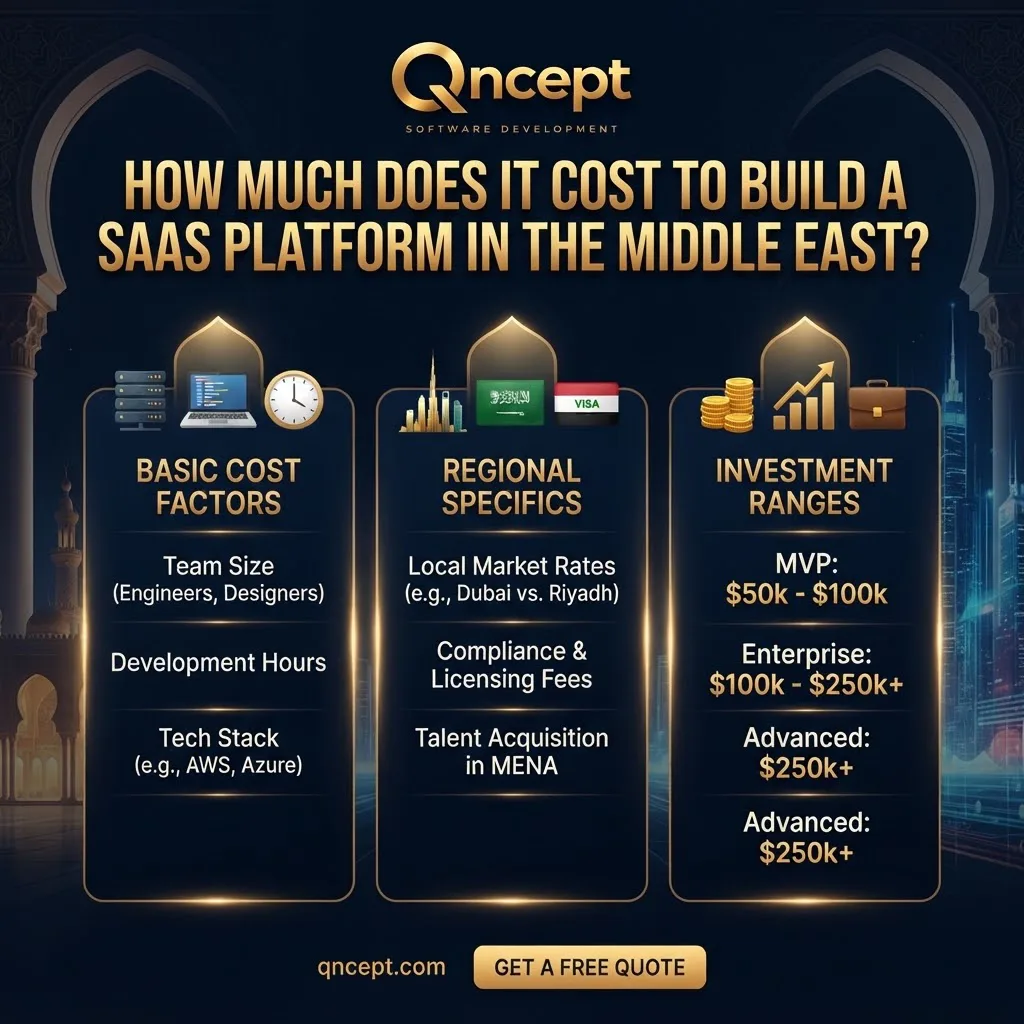
# How Much Does It Cost to Build a SaaS Platform in the Middle East?
Building a SaaS platform in the Middle East can cost anywhere from **$20,000 to more than $250,000**, depending on the product’s complexity, features, integrations, security requirements, development team, and target market.
For startups, however, the most important question is not simply **“How much does SaaS development cost?”**
It is:
**“How much should I invest to launch a SaaS product that customers will actually pay for?”**
This guide breaks down the **cost of building a SaaS platform in the Middle East**, including development, design, cloud infrastructure, integrations, security, maintenance, and the factors that can significantly change your budget.
---
## SaaS Development Cost in the Middle East
A typical SaaS project can fall into one of these ranges:
| SaaS Type | Estimated Development Cost | | -------------------------- | -------------------------: | | Simple SaaS MVP | $20,000 – $40,000 | | Standard B2B SaaS | $40,000 – $80,000 | | Advanced SaaS Platform | $80,000 – $150,000 | | Enterprise SaaS | $150,000 – $250,000+ | | Complex AI / Data Platform | $100,000 – $300,000+ |
These are general estimates. The actual cost depends heavily on the product requirements and the team building it.
For example, a simple appointment management SaaS may require only authentication, subscriptions, dashboards, and basic notifications.
A B2B ERP or CRM platform may require:
* Multi-tenant architecture * Role-based permissions * Complex workflows * Financial modules * Third-party integrations * Reporting and analytics * Mobile applications * APIs * Advanced security * Arabic and English support
Naturally, the development cost will be significantly higher.
---
# What Is a SaaS Platform?
**SaaS (Software as a Service)** is a software business model where customers access an application through the internet, usually by paying a recurring subscription.
Examples include CRM, accounting, HR, project management, logistics, healthcare, real estate, and marketing platforms.
Instead of installing software on every customer's computer, a SaaS provider hosts the application centrally and manages updates, infrastructure, security, and maintenance.
This makes SaaS particularly attractive for businesses targeting the growing digital economy across markets such as:
* Saudi Arabia * United Arab Emirates * Egypt * Qatar * Kuwait * Bahrain * Oman
---
# What Determines the Cost of Building a SaaS Product?
There is no fixed SaaS development price because several variables affect the final budget.
## 1. Product Complexity
The complexity of your SaaS platform is usually the biggest cost factor.
### Simple SaaS
A simple SaaS product may include:
* User registration * Login * User profiles * Basic dashboard * Subscription plans * Payment integration * Basic notifications * Admin panel
Estimated cost:
**$20,000 – $40,000**
### Medium-Complexity SaaS
A more sophisticated B2B platform may include:
* Multi-tenant architecture * Teams and organizations * Role-based access * Advanced dashboards * Workflow automation * Reports * APIs * Third-party integrations * Subscription management * Audit logs
Estimated cost:
**$40,000 – $80,000**
### Complex SaaS
Enterprise-level platforms can include:
* Complex business workflows * Advanced analytics * AI capabilities * Multiple applications * Mobile apps * Extensive APIs * Enterprise integrations * Advanced security * High availability * Custom infrastructure
Estimated cost:
**$80,000 – $250,000+**
---
# 2. SaaS UI/UX Design
A SaaS platform needs more than attractive screens.
The interface must allow users to complete complicated business processes quickly and with minimal training.
UX design may include:
* User research * User journeys * Information architecture * Wireframes * Interactive prototypes * Design systems * Desktop interfaces * Mobile interfaces * Arabic RTL support
Depending on the project, UI/UX design can represent approximately **10–15% of the initial product development budget**.
---
# 3. Multi-Tenant SaaS Architecture
One of the most important technical decisions is whether the application will support multiple companies from the beginning.
A multi-tenant SaaS platform allows multiple organizations to use the same application while keeping their data isolated.
For example:
**Company A → Users → Data**
**Company B → Users → Data**
**Company C → Users → Data**
The architecture must ensure that one company's users cannot access another company's information.
This affects:
* Database architecture * Authentication * Authorization * Data isolation * Billing * User management * Reporting * Scaling * Infrastructure
If you plan to build a real SaaS business rather than a single-company application, **multi-tenancy should be considered early in the architecture**.
---
# 4. Arabic and English Support
Localization is particularly important when building SaaS products for the Middle East.
A platform targeting Saudi Arabia, the UAE, or other Arabic-speaking markets may need:
* Arabic language * English language * RTL interface * Local date formats * Local currencies * Arabic invoices * Local tax requirements * Local payment methods
Supporting Arabic properly is more than translating buttons.
The entire interface needs to support **right-to-left layouts**, including tables, dashboards, forms, navigation, charts, and notifications.
Adding localization late in development can also increase costs if the application was not designed for it from the beginning.
---
# 5. Payment Integration
Subscription-based SaaS products need reliable billing infrastructure.
Depending on the target market, you may need:
* Credit/debit cards * Recurring subscriptions * Invoices * Payment webhooks * Refunds * Coupons * Trials * Multiple currencies * Local payment gateways
For a Middle Eastern SaaS platform, payment requirements should be evaluated according to the specific countries you intend to serve.
---
# 6. Third-Party Integrations
Integrations can significantly increase development time.
A SaaS platform might need to connect with:
* Google Workspace * Microsoft 365 * WhatsApp * Meta * SMS providers * Email providers * Accounting systems * CRM systems * ERP systems * Payment gateways * Maps * Government or business APIs
Each integration has its own API, authentication process, limitations, documentation, and testing requirements.
A product with 15 integrations can therefore cost substantially more than a similar-looking application with only two or three integrations.
---
# 7. Cloud Infrastructure
SaaS products require hosting and infrastructure.
Common infrastructure expenses include:
* Cloud servers * Databases * Object storage * CDN * Backups * Monitoring * Logging * Email services * SMS * Security services
Early-stage SaaS products can often operate with relatively modest infrastructure costs.
However, costs can increase significantly as the platform gains:
* More users * More data * More API traffic * More file storage * More transactions * More background jobs
The goal should not be to build expensive infrastructure from day one.
**Build for your expected scale, not imaginary scale.**
---
# 8. SaaS Security
Security becomes increasingly important when your platform handles sensitive business data.
Depending on the product, you may need:
* Secure authentication * Password policies * Role-based permissions * Encryption * HTTPS * Secure APIs * Audit logs * Backup policies * Vulnerability testing * Monitoring * Two-factor authentication
Enterprise customers may also require additional security documentation and compliance controls.
Security should be part of the architecture from the beginning rather than something added immediately before launch.
---
# 9. SaaS Development Team
The development team itself has a major impact on cost.
A typical SaaS team may include:
* Product Manager * Business Analyst * UX/UI Designer * Frontend Developer * Backend Developer * QA Engineer * DevOps Engineer
A startup may not need all of these roles full-time.
For example, a small MVP team could potentially operate with:
**1 Product Manager + 1 Designer + 2 Developers + 1 QA/part-time DevOps**
As the product grows, additional specialists can be added.
---
# SaaS Development Cost by Development Approach
Your development approach can also significantly change the budget.
## Local Middle East Development Team
Hiring a development team within the region can provide advantages such as:
* Better understanding of local business requirements * Arabic language capabilities * Regional timezone compatibility * Easier communication with stakeholders
However, costs vary significantly between countries and companies.
## Offshore Development
Offshore teams can reduce development costs, particularly for engineering-heavy projects.
However, lower hourly rates do not automatically mean lower total project cost.
Poor communication, weak product management, technical debt, and rework can make a cheap development team considerably more expensive in the long run.
## Hybrid Development
A hybrid model can combine:
* Product management locally * UX/UI design locally * Engineering through a regional or offshore team
For many startups, this can provide a balance between product control and development cost.
---
# How Long Does It Take to Build a SaaS Platform?
Development time depends on complexity.
Typical timelines may look like:
| Product | Estimated Timeline | | ------------------- | -----------------: | | Simple MVP | 2–4 months | | Standard SaaS | 4–7 months | | Advanced SaaS | 7–12 months | | Enterprise Platform | 12+ months |
These estimates assume an actual product development process rather than simply writing code.
The biggest mistake startups make is trying to build the entire product before validating demand.
---
# How Much Does an MVP Cost?
If you're a startup, you probably don't need a $150,000 platform on day one.
A properly scoped SaaS MVP may cost around:
**$20,000 – $40,000**
The MVP should focus on the smallest set of features necessary to solve the customer's core problem.
For example, instead of building a complete CRM with 50 features, an MVP might focus on:
1. Lead management 2. Customer profiles 3. Basic pipeline 4. Task management 5. Dashboard 6. User accounts 7. Subscription billing
Once customers start using and paying for the product, additional features can be prioritized based on actual demand.
---
# Hidden Costs of Building a SaaS Platform
Development isn't the only expense.
You should also budget for:
### Product Discovery
Customer interviews, competitor research, validation, and product strategy.
### Infrastructure
Cloud hosting, databases, storage, monitoring, email, SMS, and other services.
### Maintenance
Bug fixing, security updates, dependency updates, and infrastructure maintenance.
### Customer Support
Support becomes increasingly important as the number of customers grows.
### Marketing
A great SaaS product without customer acquisition is simply an expensive software project.
You may need budget for:
* SEO * Content marketing * Paid advertising * Sales * Partnerships * Events * Outbound campaigns
---
# SaaS Maintenance Cost
After launch, SaaS development doesn't stop.
A common planning approach is to allocate approximately **15–25% of the initial development cost per year** for maintenance and ongoing development, although the actual amount varies considerably.
Maintenance can include:
* Bug fixes * Security updates * Performance optimization * Cloud infrastructure * Technical support * New features * API changes * Third-party integration updates
A SaaS product should be treated as an evolving product rather than a one-time software project.
---
# How to Reduce SaaS Development Costs
There are several ways to reduce your initial investment without destroying the product.
## Start With an MVP
Don't build 100 features when 10 can validate your business idea.
## Use Existing Services
Instead of building everything internally, use established services for:
* Authentication * Payments * Email * SMS * Analytics * Cloud storage * AI APIs
## Build a Reusable Architecture
If your long-term goal is a SaaS platform, design the core architecture for multi-tenancy and scalability from the beginning.
## Prioritize Features
Use a framework such as:
**Must Have → Should Have → Could Have → Later**
This prevents low-value features from consuming your initial budget.
## Validate Before Building
The most expensive SaaS mistake is not paying developers too much.
It's **building something nobody wants.**
Talk to potential customers before committing to a large development budget.
---
# SaaS Development Cost Example
Imagine you're building a B2B SaaS platform for businesses in Saudi Arabia.
Your MVP might include:
* Multi-tenant architecture * User management * Roles and permissions * Dashboard * Core business workflow * Subscription management * Arabic/English interface * Payment integration * Email notifications * Admin panel
A possible budget could be:
| Component | Estimated Cost | | -------------------- | --------------------: | | Product Discovery | $2,000 – $5,000 | | UI/UX Design | $3,000 – $7,000 | | Frontend Development | $7,000 – $15,000 | | Backend Development | $10,000 – $20,000 | | QA & Testing | $3,000 – $6,000 | | DevOps & Deployment | $2,000 – $5,000 | | **Estimated Total** | **$27,000 – $58,000** |
The numbers are illustrative rather than a fixed market quotation.
---
# Is Building a SaaS Platform in the Middle East Worth It?
The Middle East presents opportunities for SaaS companies serving industries undergoing digital transformation.
Potential sectors include:
* Real estate * Healthcare * Logistics * Retail * Construction * Education * Hospitality * Finance * Human resources * Field services * Business management
However, geographic opportunity alone does not make a SaaS business successful.
The real question is whether your product solves a **frequent, expensive, and painful problem** for a clearly defined customer.
A strong SaaS opportunity usually has:
**Clear problem + paying customer + recurring need + measurable ROI + scalable software delivery**
---
# Final Thoughts
The cost of building a SaaS platform in the Middle East can range from **around $20,000 for a focused MVP to $250,000+ for complex enterprise platforms**.
But development cost should not be your only consideration.
A better approach is to determine:
1. Who is the target customer? 2. What expensive problem are you solving? 3. What is the minimum product required? 4. How much will customers pay? 5. How will you acquire the first 100 customers? 6. What integrations are actually necessary? 7. How will the platform scale? 8. What is the expected ROI of the investment?
If you can answer these questions before development begins, you can significantly reduce wasted development costs and increase your chances of building a commercially viable SaaS product.
**Need to build a SaaS platform for the Middle East?**
Start with the business problem, define the MVP, validate it with real customers, and then build the technology around proven demand.