# Product Engineer: How AI Is Reshaping the Role of Software Product Development
## Introduction: From Writing Code to Building the Entire Product
For decades, software product development relied on collaboration between multiple specialists. Product Managers defined problems and priorities, UI/UX Designers shaped user experiences, Software Engineers translated requirements into code, and QA teams validated the results before release.
Artificial intelligence is changing how many of these tasks are performed.
Developers can now use tools such as Cursor, Claude Code, and GitHub Copilot to generate code, modify applications, write tests, and debug issues. Tools such as Lovable can also accelerate the creation of working prototypes.
This shift is increasing the importance of the **Product Engineer** — a role that combines product thinking, hands-on engineering, and a focus on solving real user problems.
However, one distinction matters: Product Engineer is not a job invented by AI. It is an established engineering role whose practices and capabilities are evolving alongside AI-assisted development.
## 1. What Is a Product Engineer?
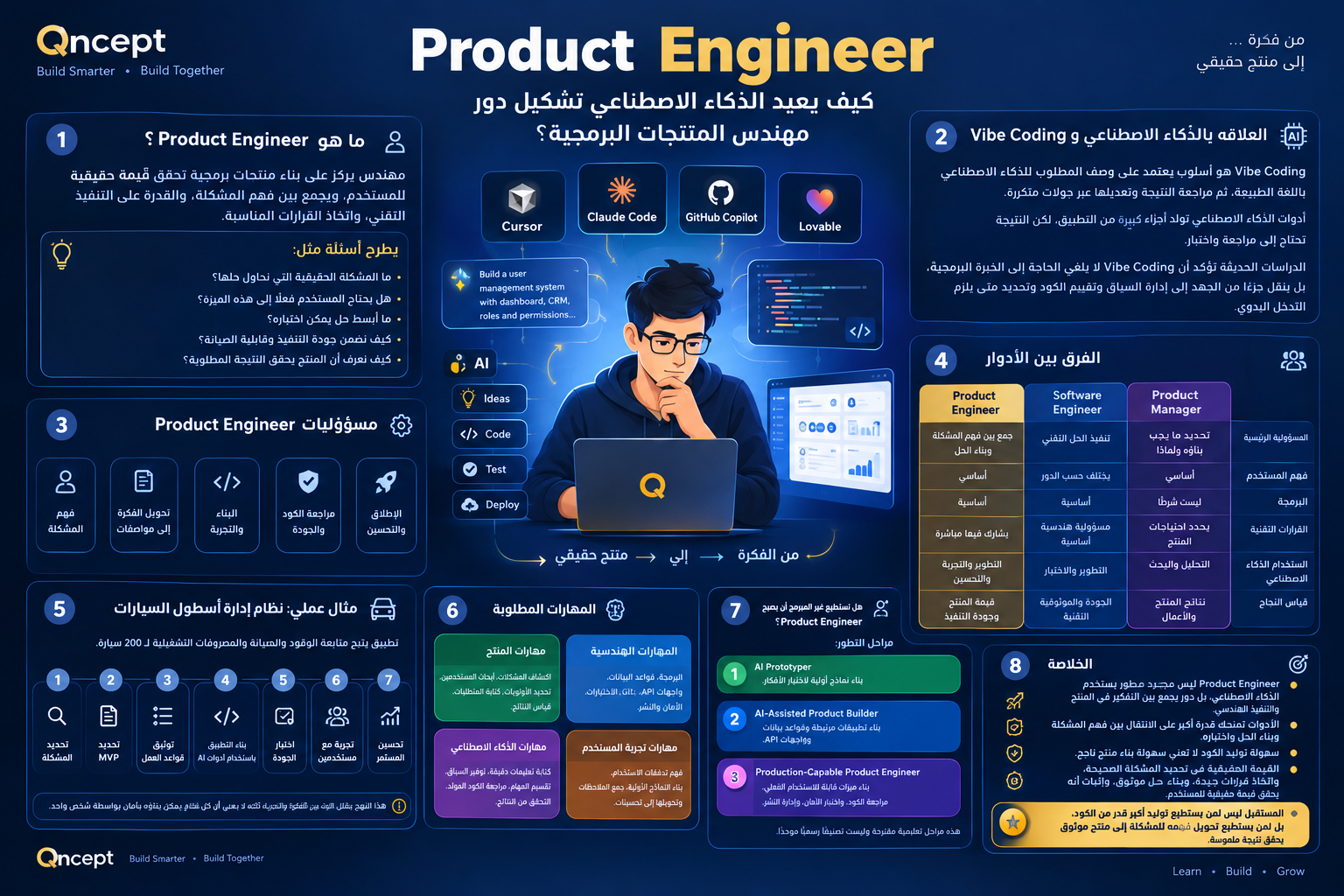
A Product Engineer is an engineer who focuses on building software products that deliver real value to users and participates in decisions about what to build and how to build it.
Rather than simply implementing specifications, a Product Engineer works to understand the problem, test potential solutions, build features, validate their quality, and improve them based on results.
They ask questions such as:
- What problem are we actually solving? - Does the user really need this feature? - What is the simplest solution we can test? - How can we implement the solution correctly and maintainably? - How will we know whether the product delivers the intended outcome?
The fundamental shift is from focusing exclusively on completing assigned development tasks to taking broader responsibility for the solution delivered to users.
## 2. How Are AI and Vibe Coding Changing Product Engineering?
Vibe Coding describes an approach in which developers communicate their intentions to AI using natural language, then review, test, and refine the generated output through repeated iterations.
For example, a developer might ask an AI coding assistant to build a CRM with a dashboard, sales pipeline, database, and user permissions.
AI tools can generate substantial portions of the application, but the output still requires review and testing.
A 2025 empirical study published by Microsoft Research found that Vibe Coding does not eliminate the need for programming expertise. Instead, it shifts some of the work toward managing context, evaluating generated code, and deciding when manual intervention is necessary.
A separate study published in IEEE Access in December 2025 examines both the opportunities and risks of this development approach, including faster implementation and concerns about code quality and responsibility.
The distinction is therefore clear: generating an application quickly is not the same as engineering a reliable application that can be maintained over time.
## 3. What Are the Main Responsibilities of a Product Engineer?
### Understand the Problem
Work with users and stakeholders to understand their needs, identify high-priority problems, and avoid building features that have not demonstrated meaningful value.
### Translate Ideas into Specifications
Define user flows, business rules, acceptance criteria, edge cases, data requirements, integrations, and permissions.
### Build and Experiment
Use engineering skills and AI-powered tools to develop prototypes and production features, then validate them with users.
### Review Code and Validate Quality
Verify business logic, data integrity, access controls, testing, security, performance, and maintainability.
### Launch and Improve
Monitor product performance, analyze user feedback, and continuously improve the solution based on evidence and actual results.
## 4. Product Engineer vs. Software Engineer vs. Product Manager
| Dimension | Product Manager | Software Engineer | Product Engineer | |---|---|---|---| | Primary responsibility | Define what to build and why | Design and implement the technical solution | Combine problem understanding with hands-on implementation | | User understanding | Essential | Varies by role | Essential | | Coding | Not a core requirement | Core skill | Core skill in engineering roles | | Technical decisions | Defines product needs | Primary engineering responsibility | Directly involved | | AI usage | Research and analysis | Development and testing | Development, experimentation, and iteration | | Success measures | Product and business outcomes | Technical quality and reliability | Product value and implementation quality |
These distinctions are guidelines rather than strict boundaries. Some Software Engineers contribute significantly to product decisions, while some Product Managers can build applications themselves.
The defining characteristic of Product Engineering is the combination of product understanding and hands-on implementation within an engineering role.
## 5. A Practical Example: Building a Fleet Management System
Imagine a company operating 200 vehicles that needs to track fuel consumption, maintenance, and operating expenses.
A Product Engineer could approach the problem as follows:
1. Identify the core problem by working with fleet managers. 2. Define an MVP covering vehicle records, expenses, and maintenance. 3. Document business rules, such as cost-per-kilometer calculations and maintenance schedules. 4. Use AI coding tools to build the interfaces, database interactions, and business logic. 5. Validate calculations, permissions, and data integrity. 6. Test the system with a limited group of users. 7. Improve the product based on results and involve specialists when necessary.
This approach can shorten the time between an idea and a working experiment. It does not mean that every system can be built safely by one person. Complex applications still require specialized engineering expertise.
## 6. What Skills Does a Product Engineer Need?
**Product skills:** Problem discovery, user research, prioritization, requirements definition, and outcome measurement.
**Engineering skills:** Programming, databases, APIs, Git, testing, debugging, and fundamentals of security and deployment.
**AI-assisted development skills:** Writing precise instructions, providing context, decomposing tasks, reviewing generated code, and validating results.
**User experience skills:** Understanding user journeys, building prototypes, gathering feedback, and translating insights into improvements.
A Product Engineer does not need to be an expert in every discipline. However, they need strong technical foundations and professional judgment to identify problems and recognize when specialist support is required.
## 7. Can a Non-Programmer Become a Product Engineer?
A Product Manager or Business Analyst can begin building prototypes and simple applications using AI coding tools. However, using these tools alone does not establish engineering competence.
A practical learning progression consists of three stages:
- **AI Prototyper:** Builds prototypes to test ideas. - **AI-Assisted Product Builder:** Builds integrated applications, works with databases and APIs, and validates functionality. - **Production-Capable Product Engineer:** Builds production features, reviews code, tests security and permissions, and manages deployment and maintenance.
These are suggested learning stages, not standardized industry classifications.
Reaching the final stage still requires knowledge of programming, databases, testing, and software architecture, even when AI handles a substantial portion of implementation.
## 8. Will Product Engineers Replace Traditional Roles?
Not necessarily.
Smaller teams may be able to deliver more with fewer handoffs between specialists. Some engineers may become more involved in product decisions, while Product Managers may be able to validate ideas through working prototypes much faster.
However, complex and reliable systems still require expertise in security, infrastructure, data engineering, testing, and compliance.
Faster code generation also does not guarantee that a team has chosen the right problem or achieved product-market fit.
The more important change is that AI expands the capabilities of certain roles and changes how responsibilities are distributed. It does not eliminate the need for human expertise.
## 9. How to Get Started
1. Choose a real problem you understand well. 2. Document the requirements and business rules before development. 3. Build a prototype using an AI coding tool. 4. Connect the application to real data and functional services. 5. Test correctness, permissions, and edge cases. 6. Deploy a controlled and secure pilot. 7. Collect user feedback and improve the product. 8. Build a portfolio that demonstrates the problem, the solution, and the quality of your implementation.
Do not make your portfolio merely a collection of attractive interfaces. Demonstrate that you can build a working solution, validate its behavior, and explain your engineering decisions.
## Conclusion
Product Engineer is not simply a new name for a developer who uses AI, nor is it a role that first appeared with Vibe Coding.
It is an engineering role that combines product thinking with hands-on implementation, while AI tools expand the ability to move between understanding a problem, building a solution, and testing it.
However, generating code more easily does not make building a successful product easy.
The real value remains in identifying the right problem, making sound decisions, building a reliable solution, and demonstrating that it delivers meaningful value to users.
**The future will not belong to those who generate the most code, but to those who turn a deep understanding of the problem into reliable products that deliver measurable results.**
## References
1. **Microsoft Research — Vibe Coding: Programming Through Conversation with Artificial Intelligence (2025).** An empirical study of workflows, debugging, and the continuing importance of programming expertise. https://www.microsoft.com/en-us/research/publication/vibe-coding-programming-through-conversation-with-artificial-intelligence/
2. **IEEE Access — Vibe Coding as a Reconfiguration of Intent Mediation in Software Development (2025).** Examines how AI changes the relationship between developer intent and code implementation, including the opportunities and associated risks. https://doi.org/10.1109/ACCESS.2025.3645466
3. **OpenAI Careers — Product Engineer, Full Stack – Agents.** A real industry example of a Product Engineer role combining product experience development with backend systems for AI-powered applications. https://openai.com/careers/product-engineer-full-stack-agents-san-francisco/
4. **Vibe Coding in Software Development: A Multivocal Literature Review (2026).** Reviews the available literature on benefits and risks, highlighting that evidence about long-term software quality and maintainability remains limited. https://papers.ssrn.com/sol3/papers.cfm?abstract_id=7194448